ECHO
Training Protocol
Strength doesn't happen by accident. This is your system.
Provided by IMOC
New user? Get your access code at thetrainingbox.training/buy
1 of 5
How long have you been training consistently?
This sets your starting track and how the program is structured.
2 of 5
How comfortable are you pushing close to your limit?
1 = very cautious, prefer to stop early. 10 = fully comfortable training hard.
5
Very cautiousFully comfortable
3 of 5
Minimum training days per week?
Pick what you'll reliably hit — not your best week, your average week.
4 of 5
What equipment do you have access to?
Select all that apply. Your exercise options will be filtered to match.
5 of 5
Any movements to avoid?
We'll keep these as notes — you can still adjust exercise picks manually.
Today's Session
Your Plan
The Framework
Why this program exists
▼
Most people train without a framework. They pick exercises they like, work hard when they feel like it, and wonder why they're not getting anywhere after two years. This program exists to close that gap. Every decision in it — the set structure, the rep ranges, the RIR targets, the exercise order — was made for a reason. Understanding those reasons turns you from someone following a plan into someone who understands how to train. That's the difference between showing up and actually making progress.
Stimulus, Recovery, Adaptation — the only loop that matters
▼
Muscle grows in three phases, not one. First, the training session creates a stimulus — mechanical tension on muscle fibers that signals the body to adapt. Second, you recover — the muscle repairs, the nervous system resets. Third, adaptation happens — the body rebuilds slightly stronger to handle that stress better next time. Most people only think about the stimulus. They add more sets, more days, more intensity, and wonder why they're stalling. The recovery window is where the actual result is built. If you don't recover between sessions, you're re-damaging tissue that hasn't finished adapting. That's not harder training — it's no training.
Why mechanical tension — not the burn — is the signal
▼
The burn you feel during a set is metabolic stress — a buildup of byproducts from energy production. It's real, and it can contribute to adaptation at high enough intensities. But it's not the primary signal for muscle growth. Mechanical tension is. Tension is the force applied to a muscle fiber as it contracts against resistance. The closer you get to momentary muscular failure — the point where you can't produce enough force to complete another rep — the higher the tension on each individual fiber. This is why RIR matters. Not because of some formula, but because tension is what triggers the adaptive response. Training far from failure leaves tension on the table.
What RIR actually measures
▼
RIR stands for Reps in Reserve. It's a measurement of proximity to failure — not intensity, not effort, not how hard something feels. RIR 0 means you could not have done another rep with good form. RIR 1 means one rep remained. The reason we use it is because it's self-regulating. Your capacity changes daily — sleep, stress, hydration, accumulated fatigue all affect how much you can actually produce on any given set. A fixed weight doesn't account for that. RIR does. If the weight that felt like RIR 1 last week now feels like RIR 2, you go up. If the same weight feels like RIR 0, you stay. The number anchors the intent of the set regardless of what you're capable of that day.
Potentiation — why you go heavy before you go hard
▼
Post-activation potentiation (PAP) is a well-documented physiological phenomenon. A maximal or near-maximal contraction — your Potentiation Set — causes your nervous system to recruit a higher number of motor units and increases the firing rate of those units for the next several minutes. In plain terms: your muscles become temporarily more capable after a very heavy effort. The Working Sets that follow benefit from that activated state. You can produce more force, handle more weight, and complete more quality reps than you could have without the Potentiation Set. This is why the heavy set comes first. Not to prove something. To set up the sets that actually build the muscle.
Motor units — what's actually happening in the muscle
▼
A motor unit is a nerve cell and all the muscle fibers it controls. Low-force tasks recruit small, slow-twitch motor units. As effort increases, the nervous system recruits progressively larger, fast-twitch units — the ones with the most growth potential. Near the end of a hard set, when smaller motor units begin to fatigue, the largest motor units are forced to step in to maintain force output. Those are exactly the fibers you're trying to train. Training far from failure means you never fully recruit them. Training near failure — and potentiating before your working sets — means you spend more of your working sets with those high-threshold fibers active and under tension. That's the mechanism.
The psychology of intentional training
▼
There's a difference between going to the gym and training. Most people go to the gym. They follow a general plan, put in effort, and leave. Intentional training means every set has a specific purpose, a measurable target, and an expected output. When you know that Working Set 1 is 8–10 reps at RIR 1, and you log 9 reps at 135lb, you have a data point. Next session, you're not guessing — you're targeting 10 reps at 135 or 9 reps at 140. That specificity changes your relationship with training. The session stops being about how hard it felt and starts being about what you accomplished relative to what you're trying to accomplish.
Consistency compounds — why showing up beats going hard
▼
Over a 12-week block, a person who trains at 85% effort four times a week outperforms someone who trains at 100% effort two times a week and misses days from being too beaten up. The math is straightforward: more sessions, done at high-but-sustainable intensity, accumulates more adaptive stimulus. The RIR system is designed around this. RIR 1 on working sets is not sandbagging — it's the intensity level that produces the training stimulus without generating the systemic fatigue that derails the following session. The goal is not to leave the gym destroyed. The goal is to come back in 48 hours and do it again, slightly better.
Reading your own log — the skill most people never develop
▼
The log is your only objective data point. Everything else is subjective — how it felt, how you looked, whether you were tired. The log tells you what you actually did. Over weeks, a log reveals patterns that are impossible to see session to session: which exercises you're progressing on, which have stalled, which are progressing too fast (a sign of undertraining). Learning to read your log means asking: did I add a rep or add weight since last time? If yes — you adapted. If not — something needs to change. The log doesn't lie. It's also the only thing that keeps you honest when the session felt harder than it was.
Set by Set
Why we train with reps left (RIR)
▼
Going to absolute failure every set isn't smarter — it's just harder to recover from. RIR lets you train at high intensity without burning out your ability to recover and come back. A RIR 1 set and a set to failure produce nearly identical muscle stimulus. The difference shows up later in the week when you're still feeling it three days out. We use RIR to control that. The number tells you when to stop — not your mood, not the burn.
What's a Potentiation Set
▼
A Potentiation Set is your heaviest set of the exercise. The goal is not to grind — it's to wake up your nervous system before your working sets. When you lift near your max on the first work set, your CNS activates more motor units. Those motor units stay recruited through your working sets, which means you can produce more force, move more weight, and do better quality reps than if you'd skipped the heavy set entirely. This is called post-activation potentiation. The Potentiation Set doesn't build the muscle on its own — it sets up the Working Sets to do that. Load it heavy enough that hitting the top of the rep range at RIR 0 is hard but clean.
Why the rep range is tight
▼
The rep range tells you exactly what the set is supposed to do. 8–10 means you load a weight where you'll hit somewhere in that window at the prescribed RIR. If you're hitting 13, the weight is too light. If you're hitting 6, it's too heavy. Two reps of margin is enough to account for day-to-day variation. More than that and the set stops being specific.
Progressive overload — the only rule that matters
▼
Stimulus. Recovery. Adaptation. That's the loop. The log is how you track it. If you're doing the same weight for the same reps for three weeks straight, nothing is changing. Every session, look at your last log. The goal is to add a rep or add weight — not both at once, just one. When you can hit the top of the rep range at the right RIR, you earn the weight increase.
How your track was assigned
▼
Your answers at setup determine your track: Learn, Build, or Refine. Learn focuses on technique and consistency with moderate volume. Build introduces Top Sets and structured back-off work. Refine uses heavier loads and tighter rep ranges. The track isn't permanent — it adjusts as you progress. If it ever feels off, you can retake the setup from your profile.
What a Prep Set is
▼
A Prep Set is a lighter warm-up done before your working sets. It uses the same movement pattern at a lower load — roughly 50–60% of what you'll use for your working sets. The goal is to get the pattern sharp, not to fatigue. You're not logging performance on a Prep Set, just getting the tissue ready and locking in the movement.
ECHO
Training Protocol
by Edgar Benitez
An echo isn't just a sound — it's a signal that comes back stronger the more times it repeats. That's exactly what this program does. Your heavy set echoes into your back-off sets — same movement, higher reps, your nervous system still primed and firing. Your Exercise A echoes into Exercise B — same muscle, second angle, still loaded and responsive. And every week you come back, you're a stronger echo of the week before. Heavier. More controlled. More capable. The name is the method: repeat with purpose. Build every time you come back. Nothing you put in is wasted — it reverberates forward.
Most people go to the gym without a real framework. They pick exercises they like, work hard when they feel like it, and wonder why they look the same after two years. The problem isn't effort — it's structure. ECHO gives you the structure. Every decision in this program — which exercises you do, what order you do them in, how many reps, how heavy, how close to failure — is connected to a reason. When the structure makes sense to you, the training becomes intentional. And intentional training is the only kind that builds on itself over time.
Every muscle group in your plan is trained as a block. A block means you pick two exercises for the same muscle — Exercise A and Exercise B — and you train both of them in sequence before moving on. Exercise A is your primary movement: a compound or loaded lift that drives the most stimulus for that muscle. Exercise B is your support movement: an isolation or angle variation that hits the same muscle from a different position while it's still active and firing from the A exercise. They're not two random exercises — they're two angles on the same target. Chest press followed by a pec deck. Leg press followed by a leg extension. RDL followed by a leg curl. Same muscle, two ways, every time. That's what an ECHO block is.
Every exercise — both A and B — follows the same four stages. Not just the big compound lifts. Every single exercise in your plan goes through all four stages, every session.
Stage 1 — Prep Set
You start light — roughly half your working weight, 15–20 reps at 5 RIR. This is not training. It's preparation. The higher rep count gives you enough volume to actually prime the movement pattern, not just walk through it once. You're getting the tissue warm, the pattern sharp, and the setup dialed in before the weight goes up. Never skip this. A missed prep set shows up as a sloppy heavy set.
Stage 2 — Heavy Potentiation Set
This is your heaviest set of the exercise. The goal is not to grind — it's to activate your nervous system at a high level. A heavy effort recruits more motor units and keeps them firing. The back-off sets that follow will produce more force, more reps, and more quality stimulus because this set happened first. Load it challenging. This set is the setup for everything that follows.
Stage 3 — Back-off Set 1
Drop the weight roughly 10%. Your nervous system is primed from the heavy set, so this first working set should feel strong. Hit the full rep range at your prescribed effort — one or two reps left in the tank. This is where adaptation starts. Log your weight and reps every time.
Stage 4 — Back-off Set 2
Same target as Back-off 1. Same weight, same rep range, same effort. This set tells you whether the weight was right. If you hit the top of the range both sets at your target effort, the weight goes up next session. If you fell short, you stay. The log is how you know. Progress in ECHO is measured one rep or one pound at a time, not by how hard it felt.
In ECHO, you pick the specific exercises within each muscle group — not us. That's intentional. This program pushes you close to failure on your working sets. That's where the adaptation happens. But working close to failure only works if you actually trust the movement. If you're anxious about your form, second-guessing the setup, or uncomfortable under the load, you won't push where you need to push — and the rep you leave in the tank isn't caution, it's wasted potential. Pick exercises you've done before. Movements you understand. Ones you can load, grind through, and repeat with confidence. The point isn't to use the most impressive exercise on paper — it's to find the one you can execute hard, repeatedly, and safely. ECHO does the programming. You bring the right tools.
This is the part most people don't understand. If you've ever done a heavy single or a near-max effort and noticed that the sets after it felt unusually strong — that's post-activation potentiation. It's a real, documented physiological response. A maximal or near-maximal effort causes your nervous system to recruit more motor units and fire them faster. That elevated state carries into the next few sets. By putting your heaviest set before your working sets, you're not burning out first — you're turning the system up so the working sets produce more than they could have otherwise. The potentiation set is not the hard work. It's what makes the hard work work better.
Weeks 1–2: Learning the Structure
Everything feels new. Your job in these two weeks is to understand the structure — not to max out. Calibrate your weights so the rep ranges feel right at the prescribed effort. The heavy set will feel heavy. That's correct. By the end of week two, the four stages should start to feel like one connected sequence instead of four separate things.
Weeks 3–4: The System Clicks
The potentiation effect becomes noticeable. Your back-off sets feel more productive than they did week one — because your nervous system now knows what to do after the heavy set. Weights will start moving. Log every session. The log is how you know progress is real and not just how it felt.
Weeks 5–6: The Echo
This is where the program earns its name. You'll start to feel the A exercise echoing into the B exercise — a heavy RDL opening up your leg curls, a loaded chest press making the pec deck feel different. The muscle is already primed when you get to the B exercise. The two movements start to feel like one block instead of two separate exercises. That's the echo.
Weeks 7–8: You're Running It
You know your weights, your rep targets, your numbers. The structure is automatic. You're not following the program anymore — you're executing it. Progress is measurable and yours. At the end of week 8, compare your logs to week one. The numbers tell the story.
Exercise A → Exercise B — Same Muscle, Every Block
Every muscle group in your plan gets two exercises — A and B — both targeting that exact muscle. Exercise A is the primary mover. It's the heavier, more loaded movement that produces the most mechanical stimulus for that muscle. Exercise B is the support: an isolation or angle variation that hits the same muscle from a different position right after A has already primed it. The block finishes one muscle completely before moving to the next. You don't superset different muscles, you don't bounce around. One target, two angles, four stages each, in order. That's one block. Then you move to the next muscle.
Two Categories of Muscles
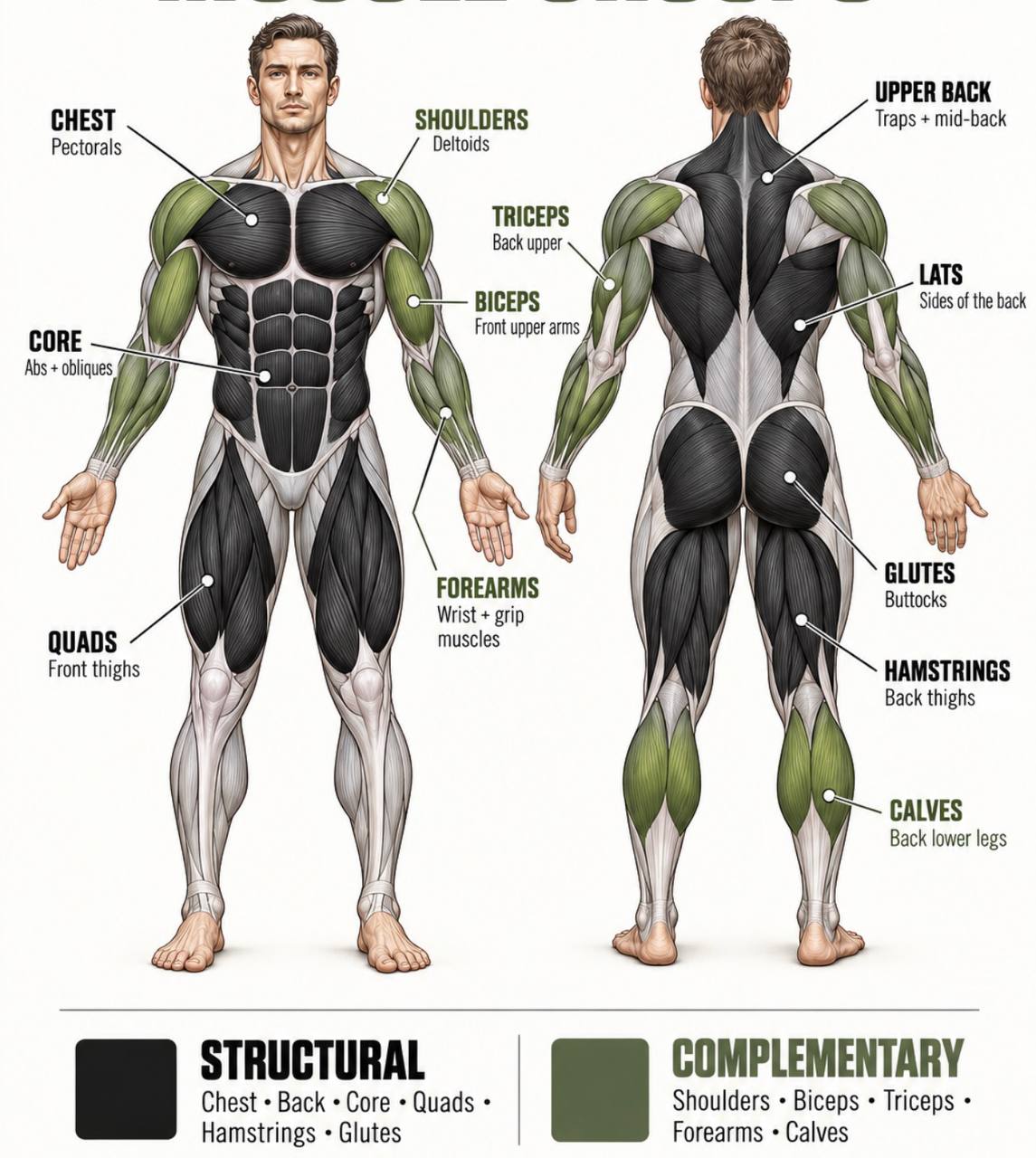
Muscle map showing structural and complementary muscle groups FRONT BACK Side Delts Biceps Chest Core Quads Upper Back Lats Glutes Hamstrings Triceps Calves
Structural
Chest · Lats · Upper Back · Quads · Hamstrings · Glutes · Core
Complementary
Shoulders · Biceps · Triceps · Forearms · Calves
Structural Muscles — The Foundation
Structural muscles are the large primary movers of the body: chest, lats, upper back, quads, hamstrings, glutes, and core. These groups carry the most load, drive the most total body adaptation, and require the most recovery. They get their own dedicated session days when you train 4 or more days per week. Each structural muscle gets a full A→B block. These are your heaviest, highest-output sessions — the ones that build the base everything else sits on.
Complementary Muscles — The Finish
Complementary muscles support and finish the structural work — shoulders, biceps, triceps, forearms, and calves. These groups receive the full ECHO treatment: a dedicated A→B block, the same 4-stage structure, the same effort standards. They're not secondary in importance — they're secondary in recovery demand. That's why they can be trained between structural sessions without compromising your ability to recover and come back to the heavy work. The separation is about managing fatigue, not ranking muscles.
2–3 Days Per Week — Full Body
When you train 2 or 3 days per week, every session covers all muscle groups. Structural and complementary muscles are combined in each workout — you hit everything in fewer, longer sessions. The block structure doesn't change. Each muscle still gets its A→B, each exercise still gets all 4 stages. The only difference is the volume is distributed across fewer days, so each session covers more ground.
How the structure works

Every exercise — both A and B — follows the same 4-stage structure. This is not optional. The structure is the framework. Understanding each stage will make every set more intentional.

Stage 1 — Prep Set
Start light — around 50% of your working weight. 15–20 reps, 5 RIR, same movement. You're not training yet. You're getting the pattern right, warming the tissue, and locking in your setup before loading it. The higher rep count is intentional — enough volume to actually prime the pattern, not just go through the motions. A missed prep set almost always shows up as a sloppy heavy set.
Stage 2 — Heavy Potentiation Set
This is your heaviest set of the exercise. Load it challenging — leave nothing on the table here. The goal is to activate your nervous system at a high level so your working sets produce more. A near-maximal effort recruits more motor units and keeps them firing. The sets that follow will be stronger because this one happened first. This is not the set that builds the muscle. It's the set that makes the muscle-building sets work better.
Stage 3 — Back-off Set 1
Drop about 10% from your heavy set. Your nervous system is already primed, so this set should feel controlled and strong. Hit the full rep range at your target effort — one or two reps left in the tank depending on your track. This is where the adaptation signal is built. Log your weight and reps. Every session.
Stage 4 — Back-off Set 2
Same weight, same target as Back-off 1. This set is your confirmation — it tells you whether the weight you picked was right. If you hit the top of the rep range at your target effort on both back-off sets, the weight goes up next session. If you couldn't, you stay. The log decides. Progress in ECHO is one rep or one pound at a time, not how hard the session felt.
The only rule that matters
Track your weights. Every session, look at what you did last time. Add a rep or add weight — not both. When you consistently hit the top of the rep range at RIR 1, that's the signal to go up. The log is how you know.